FIVE PERCENT!
By the End the Century People Won't Believe What WNBA Pay Was in 2025!

The WNBA only earned about $100 million in 2019. Given that the NBA’s revenue was nearly $9 billion that year, the WNBA was – as the trolls often mentioned -- truly a tiny operation. But the NBA wasn’t always so large. Forty years earlier, the NBA also only earned about $100 million in revenue. So – in nominal terms – the WNBA in 2019 and the NBA in 1979 were taking in the same pile of cash.
The players in each league, though, saw a different pile of cash. In 1979 both Bill Walton and Moses Malone became the first NBA players to be paid $1 million in a season. This means the NBA 45 years ago was paying about 2% of its revenue to just two players.
In 2019, the WNBA was only giving 12% of its revenue to all its players.
But that’s all a distant memory now, right?
In 2026, we now have players like A’Ja Wilson, Napheesa Collier, and Breanna Stewart --- players who will be considered WNBA legends later in this century – finally getting paid $1 million by the WNBA. Yes, the WNBA in 2026 has reached the late 1970s in the NBA!
Most people are not framing WNBA pay in 2026 like this. Virtually every article written on WNBA pay today is celebrating how far the league has come. And that is because before this year, WNBA pay was very, very bad. In fact, one could call it ugly.
How ugly? A few days ago, I spoke to Raphael Späth – a German journalist – about the WNBA’s collective bargaining agreement. For those who don’t speak German (I don’t!), here is essentially what I said.
The average WNBA player was paid $120,000 in 2025. With 182 players logging minutes, the league was paying less than $22 million in salaries. Just a few days ago, Michael Ozanian of CNBC reported that WNBA revenue in 2025 was $430 million.
With Ozanian’s report we can now answer this question:
How far did the player’s share of revenue in the WNBA finally fall?
Once again, it was 12% in 2019. By 2023, this share fell to 9%.
And in 2025 – where players were paid about $22 million of the league’s $430 million in revenue – the players were only getting FIVE PERCENT of the league’s pile of cash!
That’s it! (you can hear me say this to Raphael!).
So, Walton and Malone got 2% of NBA revenue for the 1979-80 season and 45 years later the NBA – which is the majority of owner of the WNBA – only gave 5% of WNBA revenue to all the women of the WNBA.
That is a giant gender-wage gap. At no point in the history of the NBA were men ever paid this badly.
Let me have everyone think of this story this way.
No matter what happens in the future, it will always be the case that the WNBA paid its players just 5% of revenue in 2025. That “ugly” fact will never change.
And if you think that “ugly” fact was justified by a lack of profits, please go take a class in labor economics. And one in sports economics. And then stop being so gullible when a giant organization tells you something. And, finally, stop commenting about this issue anywhere.
Hopefully as time goes by what the trolls have argued will be forgotten and all that will remain is disbelief. As I told Alanis Thames of the Associated Press a few days ago, when people look back on this time period at the end of the 21st century they simply will not understand why women in sports were treated this way.
But the numbers from 2025 are not going to change. The women of the WNBA were treated very badly last year. This was very much due to the choices the NBA (the majority owner of the WNBA) made. And nothing that happens going forward will change what happened.
Once again, 2025 is in the past and it can’t be changed. So, let’s focus on the amazing future. Going forward, the WNBA players are going to be paid 20% of WNBA gross revenue. Of course, NBA players are guaranteed 50% if the NBA’s Basketball Related Income. If we focus on gross revenue, NBA players are consistently paid more than 40% of this number. Or to put it differently, the gender-wage gap in professional basketball persists. The men of the NBA are paid at least twice as well as the women of the WNBA.
However, because 20% is so much bigger than 5%, people are celebrating how the women of the WNBA just got the largest pay increase in history. But this achievement was entirely made possible by the NBA paying the women so poorly last season. And it remains true that the NBA continues to treat the men they employ far better than they treat the women.
Yes, that is bad.
And it is especially bad when we consider the immensely good news about WNBA revenue. To put it simply the WNBA managed to skip a decade in its revenue growth. Or to put it differently, the WNBA revenue story skipped the 1970s!
It is estimated that the NBA earned about $30 million in revenue during the 1971-72 season. If we adjust this for inflation, we see the NBA earned about $230 million (in 2024 dollars) in its 26th season. By 1982-83 (the NBA’s 37th season) it is estimated NBA revenue had grown to $136 million, or about $440 million in 2025 dollars. So, in a span if eleven years the NBA saw their revenue – adjusted for inflation – nearly double.
That’s impressive.
Well, at least for a men’s league.
Forbes reported that the WNBA in 2024 – the league’s 28th season – generated $226 million in revenue. This is quite similar to what the NBA earned in 1971-72. And once again, Michael Ozanian of CNBC reported that WNBA revenue in 2025 was $430 million; or essentially what the NBA earned in 1982-83.
So, the WNBA essentially made the same leap in one year that the NBA made in the 1970s. Or – as noted earlier – the WNBA skipped the 1970s!
That’s truly impressive.
And the money for the WNBA continues to explode. The WNBA’s announcement for the new collective bargaining agreement reported average salaries in 2026 as well as average salaries in 2032 (the last year of the deal). We also learned – as noted earlier -- that across the deal the players will receive (on average) 20% of the league’s revenue. Given that we know how many teams and players are in the league each year, we can estimate how much the players are paid and therefore also estimate what the WNBA thinks will happen to league revenue.
For example, in 2026 there are 15 teams with 14 players (12 on the roster and 2 developmental players). So, there are about 210 players. If average salary is $583,000, then the players are collectively paid about $122 million. And if the players are paid 20% of league revenue – or one-fifth of league revenue – then the WNBA must think league revenue will be about $612 million this year.
In 2032, average salary is supposed to be more than $1 million. If there are 18 teams and 252 players, then the total pay to the players is at least $252 million. And that means – following the same logic in the previous paragraph -- total revenue in the WNBA that season is expected to be about $1.3 billion!
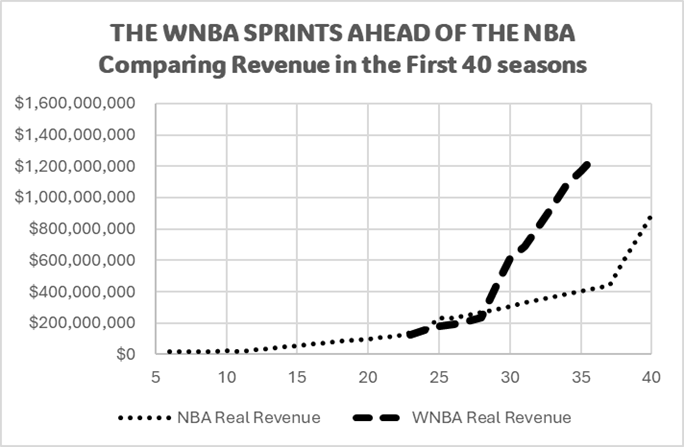
If we adjust the NBA revenue for inflation, the NBA doesn’t reach $1.3 billion until the last years of the 1980s. Or in the NBA’s fifth decade.
By the end of this current agreement the WNBA will still be in the league’s 4th decade. As the following graph illustrates, the WNBA’s revenue is growing much faster than the NBA’s revenue in its first four decades.
There is no reason to think the WNBA won’t keep growing. Investment dollars are flowing into the league. There is demand for more and more expansion teams. Sometime during the 21st century the WNBA will very much look like the NBA today.
And when that happens, people are going to wonder why the NBA only gave the women of the WNBA just 5% of league revenue in 2025. I suspect as time goes by people will question why the NBA insisted on only paying the women 20% of league revenue while league revenue was exploding.
Of course, we aren’t looking back at this from the vantage point of 2050 or 2080. We are still living in 2026. At this time, moving from “ugly” to “bad” can look “good” in a relative sense.
Still it must be said. Someday – when the WNBA is obviously worth many billions and the gender-wage gap is finally closed (yes, I think this will happen) – people will not believe how the legends of the WNBA were treated today.